Field Notes Refrigerator Repair · Bothell
One Bothell, Two Power Companies: What the County Line Changes About Outages, Panel Upgrades and Your Sub-Zero
Bothell sits on two electric grids: Puget Sound Energy serves the King County side, Snohomish County PUD the Snohomish side. That split decides your outage history, your surge exposure, and the route to a panel upgrade for a built-in Sub-Zero.
- Filed
- Reading
- 5 min
- Revised
- Applies to
- Sub-Zero built-ins · Bothell, WA
- Author of record
- Dean Halvorsen Refrigeration technician — sealed systems and airflow Years at it: 19 EPA 608 certified
The call we take most often here
The Bothell call that repeats more than any other is a built-in that came through a power interruption and has not been right since. The fresh food side sits around 50°F while the freezer is still hard-frozen, or the compressor runs without ever cycling off and the floor in front of the cabinet feels warm.
It rarely gets reported that way. The complaint arrives a day or three after the lights came back on, by which point nobody connects the two events. Ask the question in reverse — when did your power last go out, and for how long — and the timeline usually lines up. That is where the county line starts to matter, because in this city the answer depends on which side of it your meter sits.
Why this address produces it
Bothell is one city served by two electric utilities. The city’s own Comprehensive Plan Utilities Element, dated December 2024, states that electricity service areas are divided roughly along the King/Snohomish county line: Puget Sound Energy serves Bothell residents inside King County, and Snohomish County PUD serves those inside Snohomish County.
Mapped onto the districts we work in, Bothell Landing, down by the river, sits on the Puget Sound Energy side, and Canyon Park, at the northern edge of the city, on the PUD side. The boundary itself follows Northeast 205th Street, which becomes 244th Street SW north of the line, so in North Creek and Maywood Hills it is worth reading the meter rather than assuming. Snohomish County PUD describes itself as the twelfth largest public utility in the country and the second largest in Washington.
What that means at the meter is two of everything. Two outage-reporting numbers. Two restoration organisations, each with its own crews, its own priorities and its own way of sequencing a storm. Two processes and two timelines for a service or panel upgrade. Two metering authorities, and two separate appliance-rebate programs — all inside one city, for houses that share an address format and sometimes a back fence.
The chain, from cause to complaint
A Sub-Zero is a continuously running compressor load, and interruptions do not usually kill one outright. They age it. Every restoration asks the machine to restart against a sealed system that has not equalised, and the components absorbing that are the start circuit, the control board and, across enough years, the compressor itself.
Watch the sequence. Power drops. The cabinet begins to warm, slowly at first, because a built-in is well insulated and the door stays shut. Power returns, usually with the rest of the street coming back at the same moment. The compressor is commanded on before pressures have settled, draws hard, and either starts or sits stalled until its overload opens. A unit that has done this many times over many winters has a start circuit that is no longer crisp, and it shows as a compressor that struggles to get going, or one that runs and runs because it is barely moving refrigerant.
The second half of the chain is water. During the interruption the load inside gives up moisture; when everything then runs flat out to recover, that moisture ends up on the evaporator. If the defrost cycle cannot clear it, or the drain freezes, it turns up as water collecting under the crisper drawers every couple of days — a complaint that reads like plumbing and is really defrost.
Age decides how much of this matters. Maywood Hills has a lot of built-ins fifteen to twenty-five years into service that have been through every storm since the day they were installed. A Canyon Park column that went in with a newer hillside build has a far shorter history of these events behind it.
Ruling out the obvious first
Four things are worth establishing before anyone opens the machine: which utility serves the meter, when the power last failed and for how long, whether the receptacle behind the unit shares a circuit with anything else, and when the condenser was last cleaned. Two of those you can settle yourself in ten minutes.
Work them in that order. Check the panel for a breaker that has tripped, including the half-tripped ones that still look seated; reset once and no more. Confirm the unit actually has power — interior lighting and a live display. Pull the grille and clean the condenser properly, because a condenser packed with dust behaves exactly like a machine in an overheated room and produces the same never-cycles-off complaint. Check the seal with a banknote: shut it in the door and see whether it drags on the way out. A gasket that has lost its grip is why the door no longer draws itself shut on the vacuum, and it is also why the cabinet never catches up. Last, leave an independent thermometer in the fresh food section overnight instead of trusting the display.
One warning. If the unit trips the breaker as it tries to start, stop resetting it. Repeatedly forcing a stalled compressor is how a repairable machine becomes a sealed-system job.
After the outage: the valve and the ice maker
When the complaint after a power cut is no ice rather than a warm cabinet, what we usually find is that nothing has failed yet. The freezer has not come back down to temperature, and Sub-Zero’s own no-ice checklist asks for the freezer to be near 0°F and the ice maker to have been switched on for a full day before anyone judges it. Less often, on the Classic built-ins, the ice maker indicator is left flashing; the manufacturer’s guide clears it by touching MAX ICE and ICE MAKER together.
If a full day at temperature brings no ice, the water side is next, starting with the inlet valve, the electric valve that has to open for every fill. Tell Sub-Zero Repair Bothell on (206) 202-2799 how long the power was off; it changes where we start.
When it stops being a homeowner job
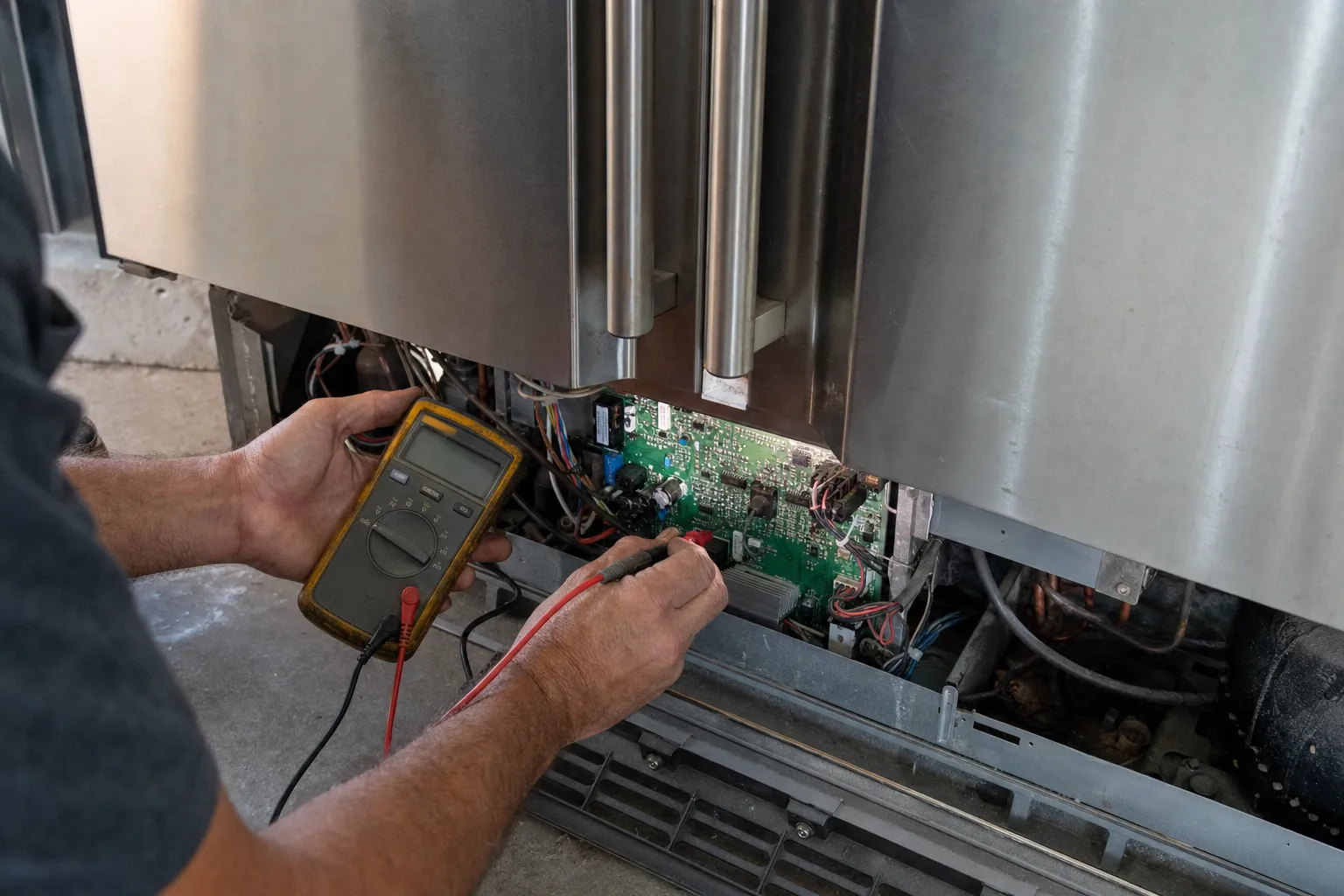
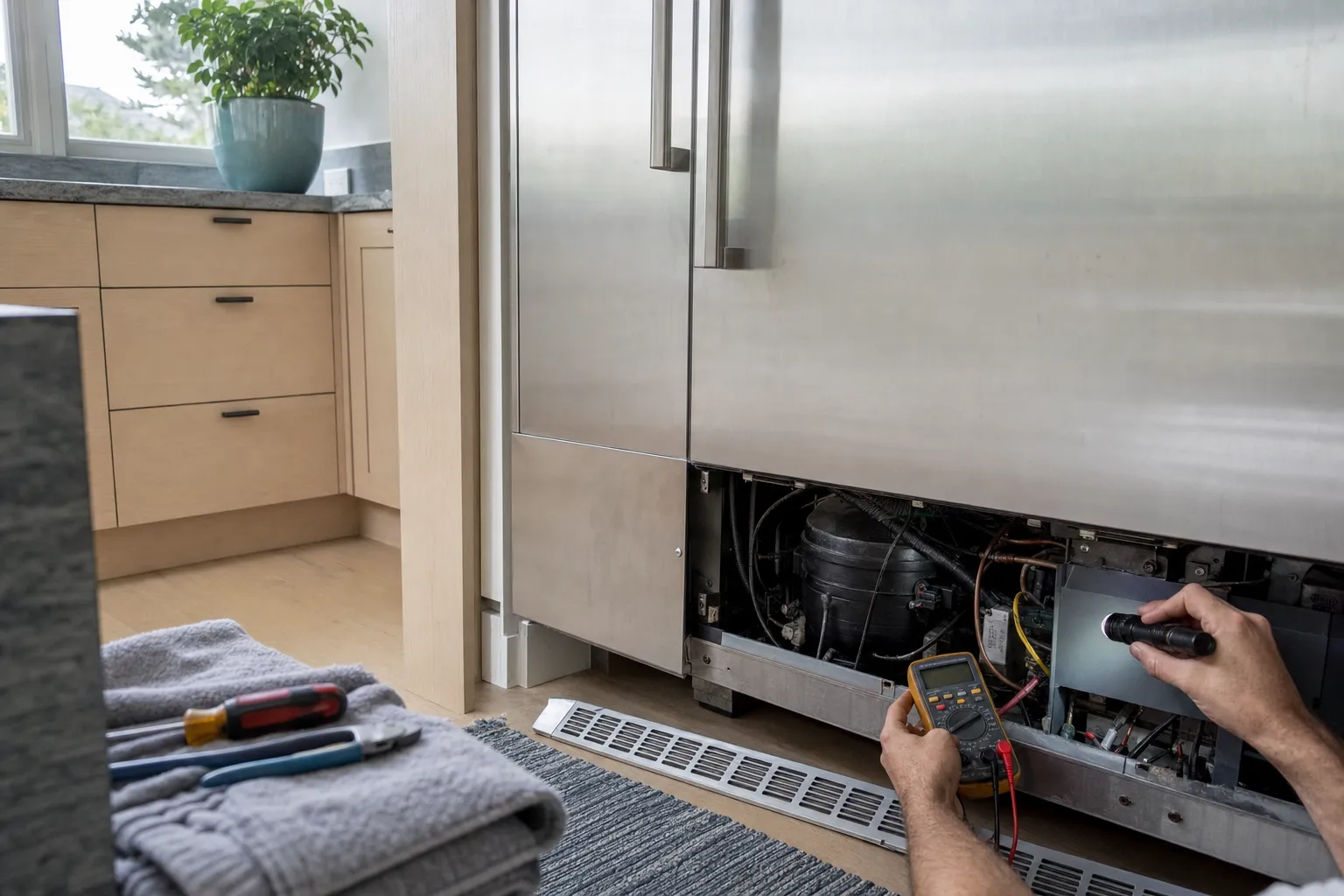
The dividing line is electrical measurement. Once the question is what the start components are doing, what the control board is reporting, or whether the compressor is pulling locked-rotor current, it needs a meter and somebody who reads one for a living. A diagnostic visit here is $89, and it buys a named fault and a price agreed before any part is ordered.
From there the work falls into the printed bands, and the parts an outage actually reaches are a short list: the electronic control board; the defrost heater, thermostat or sensor; a fan motor; and, as the outlier, the compressor or sealed system, the one band where the age of the cabinet and the state of everything else enter the decision. Every band’s range is on the costs page.
If this has now happened more than once at your address, the conversation is not only about the appliance. Whether the built-in has a dedicated circuit, and what a panel upgrade would involve, are questions with two different answers in Bothell depending on whether Puget Sound Energy or the PUD reads your meter — a different application, a different queue, a different rebate. Tell us which side of the line you are on when you call (206) 202-2799, and we will work the appliance with that in mind.
Follow-up questions
- Which electric utility serves my house in Bothell?
- It depends on which county your address falls in. Bothell's Comprehensive Plan Utilities Element says electric service is divided roughly along the King/Snohomish county line — Puget Sound Energy in the King County portion, Snohomish County PUD in the Snohomish portion. The county boundary follows Northeast 205th Street, 244th Street SW on the Snohomish side: Bothell Landing, by the river, is well south of it and Canyon Park is north of it. Near the line, the name printed on the meter or the bill settles it.
- Can a power outage damage a built-in Sub-Zero?
- A single outage rarely destroys a healthy unit. The damage is cumulative. Each time supply is restored, the compressor is asked to start against a system that has not equalised, which is hard on the start circuit and on the control board. After enough of those events a unit begins to struggle to start, or runs without ever holding temperature. Cabinets fifteen to twenty-five years old carry the longest history of it.
- The freezer is still frozen but the fresh food side is warm. What does that mean?
- That split usually points at air handling or defrost rather than at a dead compressor, because a failed compressor takes the freezer down with it. Check in this order: listen for the fan behind the rear panel, look for ice built up across that panel, then test whether the door is still sealing. Water pooling under the drawers alongside the warm side tends to confirm a defrost or drain fault.