Field Notes Freezer Repair · Bothell
Frost Keeps Coming Back in a Sub-Zero Freezer
A sheet of frost that returns within days of being cleared is a defrost fault or a seal fault, and the two look nothing alike once you know what to check. A diagnostic walk-through from Bothell service calls.
- Filed
- Reading
- 6 min
- Revised
- Applies to
- Sub-Zero built-ins · Bothell, WA
- Author of record
- Dean Halvorsen Refrigeration technician — sealed systems and airflow Years at it: 19 EPA 608 certified
Frost that you clear and that comes back within a week is not a housekeeping problem. A Sub-Zero freezer is designed to defrost itself on a schedule and to carry no visible ice on the evaporator between cycles. When frost accumulates faster than the unit can remove it, something specific has stopped working, and there are only a handful of candidates.
The good news is that this symptom rarely points at the sealed system. Almost every returning-frost call in Bothell comes down to the defrost circuit or the door, and both are a fraction of what opening the sealed system costs.
Where the frost is tells you most of the story
Before anything else, look at where the ice is actually forming. It is the single most useful observation you can make, and it takes thirty seconds.
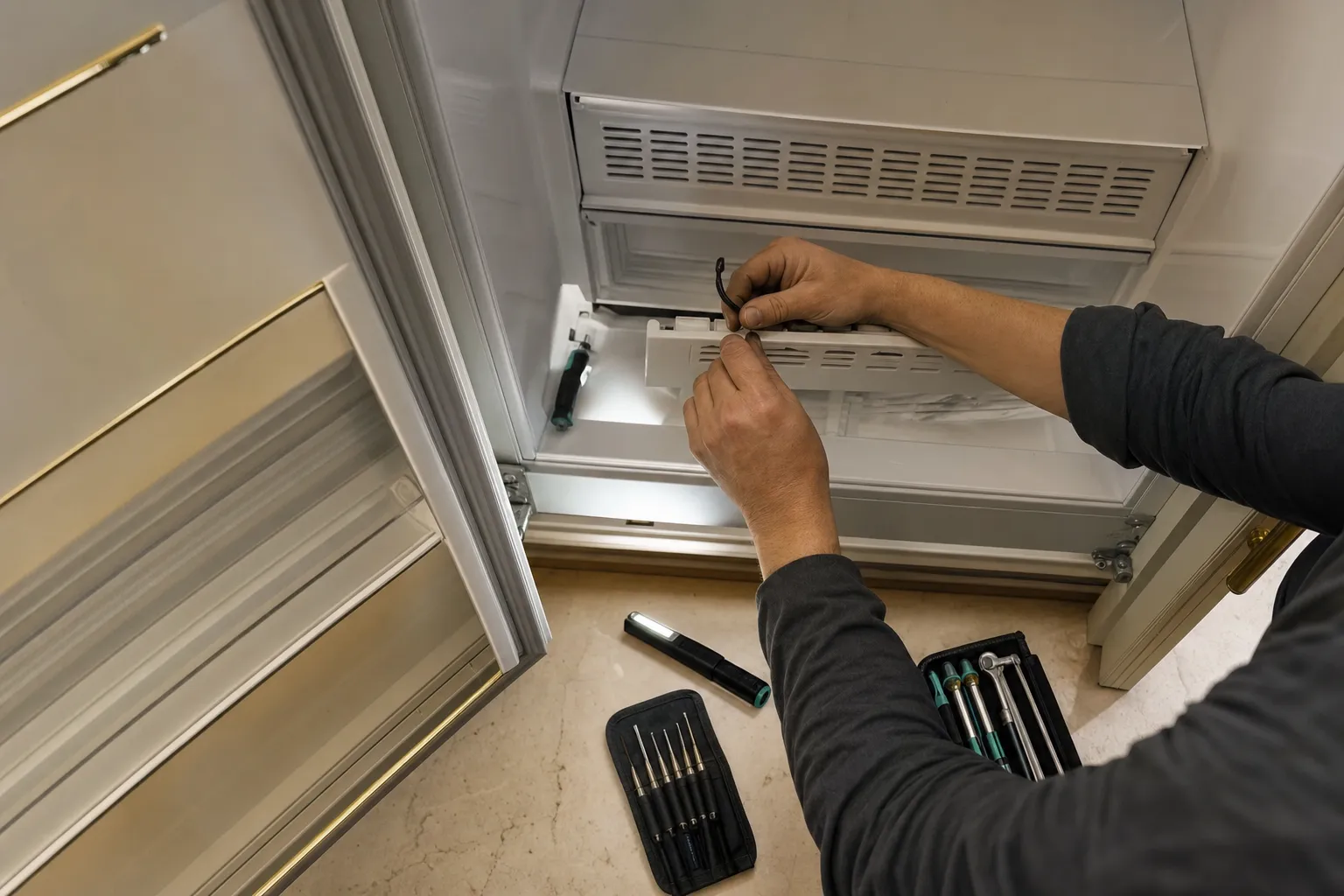
Frost on the rear panel, behind the vents. That is the evaporator, and it is the classic defrost-circuit signature. The coil should be clear between cycles. If it is carrying a sheet of ice, the defrost cycle is either not running or not completing.
Frost on the ceiling and side walls, in the food. That is moisture coming in from outside — a door or seal problem. The evaporator is doing its job; it is just being asked to remove more water than it can.
Frost around the door opening itself, or on the frame. Seal, alignment or a failed door heater on models that have one.
A solid block of ice in the bottom of the drawer. That is usually a blocked defrost drain: the unit is defrosting correctly but the meltwater has nowhere to go, so it refreezes at the lowest point.
Ice around the back of the ice maker, or a lump where the water enters. That is the water path, not the defrost circuit, and it has its own section below.
Those five patterns lead to different repairs, which is why “my freezer is icing up” is not by itself enough information to price a job over the phone.
The defrost circuit, and how it fails
A Sub-Zero freezer defrosts by energising a heater wrapped around or beneath the evaporator, on a schedule driven by compressor run time. A bimetal or defrost thermostat confirms the coil is cold enough to need it and cuts the heater off once the coil reaches temperature. The meltwater runs down a trough, through a drain, and into a pan near the compressor where it evaporates.
Three parts of that chain fail, in roughly this order of frequency:
- the defrost heater goes open circuit and simply never warms the coil
- the bimetal or defrost thermostat fails open and never lets the heater run
- the control or sensor stops calling for the cycle at all
From inside the cabinet these three look identical: a growing sheet of ice on the rear panel, a freezer that gradually loses its ability to hold temperature as the coil blocks with ice, and eventually a fresh-food section that starts climbing too on models that share air between the compartments.
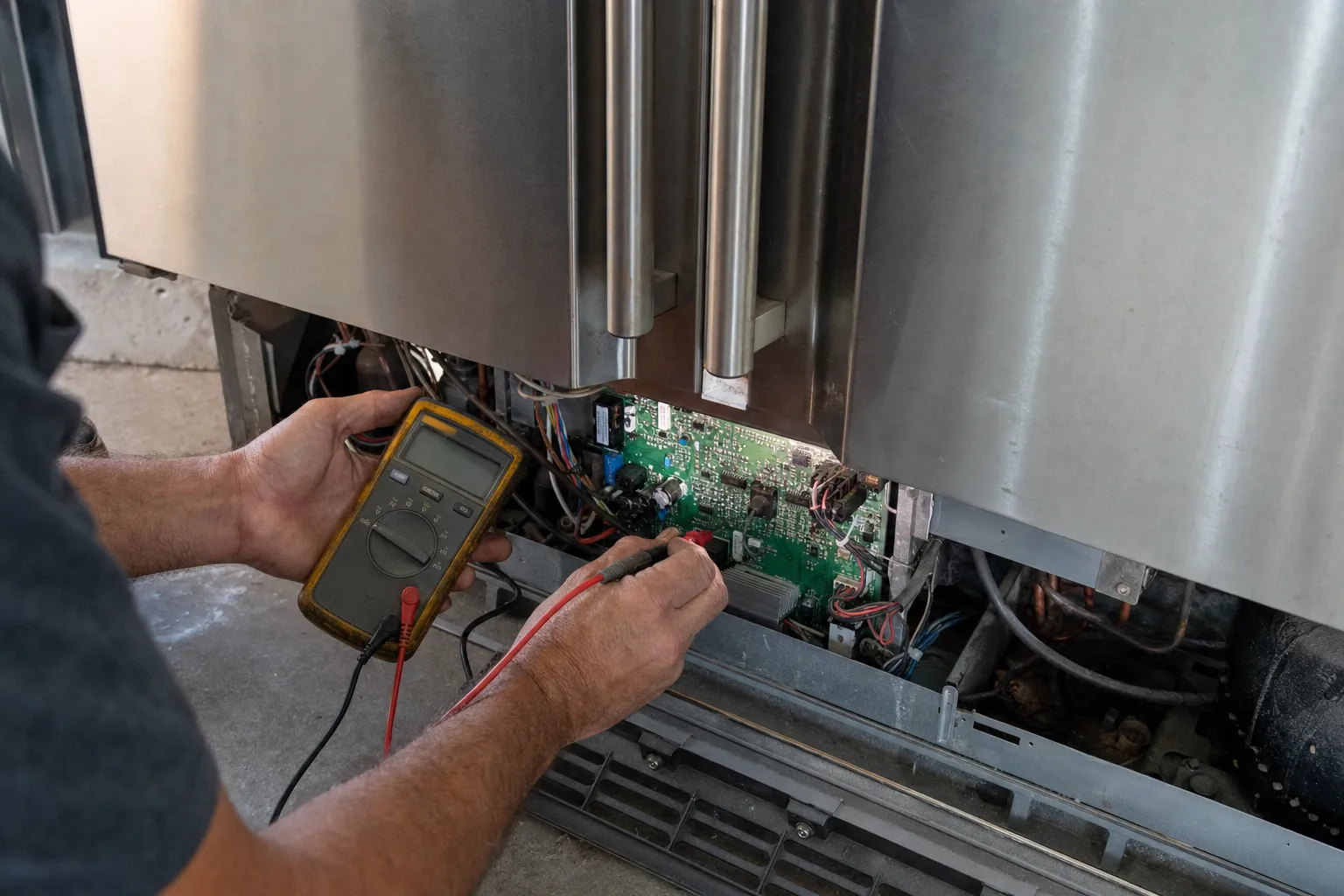
Telling them apart means putting a meter on the components with the rear panel off, and forcing a defrost cycle to see what actually energises. That is twenty minutes of work and it is the difference between replacing the right part and replacing three parts hoping one of them was it.
There is one clue you can gather yourself: note whether the freezer got worse suddenly or gradually. A heater that fails open produces a fairly sudden decline over a week or two. A drifting sensor produces a slow slide over months, often with the fresh-food side affected first.
Doors, seals and Bothell summers
If the frost is on the walls and the food rather than the back panel, stop looking at the defrost circuit. Something is letting humid air in.
Test the gasket the way a technician does: shut the door on a strip of paper and pull. Do it at six points around the frame. Anywhere the paper slides out without resistance, the seal is not making contact. Then look along the closed door edge from the side — a gasket that has taken a set and gone hard will show a visible gap at one corner.
Two local factors make this worse than people expect. First, summer humidity: every opening in July admits air carrying far more water than the same opening in January, and that water has to go somewhere. Second, garages and utility rooms. A lot of Bothell homes run a second freezer or an overflow unit in an unconditioned space, and a unit in a 90°F garage in August is fighting a load it was never specified for.
Also check the obvious mechanical causes before assuming the gasket is dead: a drawer that will not close the last half-inch because of a box of frozen peas, a unit that has been pushed back against a wall and lost its clearance, or a door that has dropped on its hinges and is now sealing on three sides out of four. Hinge adjustment is a much smaller job than gasket replacement.
The drain, and why the ice is at the bottom
If the ice is a slab at the bottom of the drawer or under the basket rather than on the coil, the defrost cycle is probably working fine and the meltwater is the problem. Drains block with a plug of ice, or with debris that has washed down the trough over the years, and once blocked the water backs up and refreezes where it stands.
Clearing it is straightforward for a technician and awkward for an owner, because the trough is behind the rear panel and forcing hot water down a frozen drain is a good way to end up with water inside the insulation. It is also worth finding out why it blocked: a drain that ices repeatedly often means the drain heater or the drain-tube clip has failed, and clearing it without fixing that just books the same visit again in four months.
Frost round the ice maker is a water problem
When the ice is packed round the back of the ice maker rather than spread across the rear panel, what we usually find is a fill tube or fill cup that has frozen over. The usual cause is water arriving badly: a valve that lets a little through between fills, so it freezes where it drips, or pressure too low to push each fill through before it sets. Sub-Zero’s own troubleshooting names low water pressure as a cause of the line or fill tube freezing, and clearing the ice from the fill tube and fill cup as the first step, with a full freezer defrost if that is what it takes.
Clearing it only buys time if the water problem stays. That is why a frozen fill tube is worth reading about on its own: the fill tube and fill cup, part by part. If it refreezes within days, the valve and the house pressure are the next things to test, and Sub-Zero Repair Bothell tests them in that order on (206) 202-2799.
What is worth doing before you call
Do these four things and the diagnosis is largely done:
- Note exactly where the frost is — rear panel, walls, door frame, round the ice maker, or floor of the drawer.
- Paper-test the seal at six points around the door.
- Put a thermometer in the cabinet for four hours and compare it with the display.
- Note whether the decline was sudden or gradual, and whether the fresh-food side is affected too.
If you clear the frost yourself on a Classic built-in, do it the way its Use and Care Guide says: the unit off, a hair dryer on low and kept moving, the water wiped up as it melts. That instruction is written for the Classic series, so on anything else check the guide that came with your own unit before reaching for a dryer. A heat gun, or a dryer parked in one place, sends meltwater toward wiring and control parts, and a straightforward defrost repair turns into a bigger one.
Follow-up questions
- How often should a Sub-Zero freezer defrost itself?
- On its own schedule, set by the control rather than by a clock you can watch, so there is no fixed hour to check. What matters is the result: the rear evaporator panel should look clear between cycles. If you can see frost thickening on it through the vents, the defrost cycle is not finishing its job.
- Is it safe to melt the frost off with a hair dryer?
- Sub-Zero's Classic Use and Care Guide allows it on those models, and only the way it is written there: the unit switched off, the dryer set on low and kept moving, the water wiped up as it melts. On any other series, ask first. A heat gun, or a dryer parked in one spot, sends meltwater where it should not go.
- Why does frost come back faster in summer?
- Every door opening admits humid room air, and Puget Sound summer air carries a lot of moisture. That water condenses and freezes on the coldest surface it finds. A marginal door seal that copes fine in February will produce visible frost in August on exactly the same unit.
- Does frost mean the freezer is about to fail?
- Usually not. The common causes are a defrost heater, a bimetal or defrost thermostat, a drifting sensor or a door seal — all ordinary parts-and-labour repairs at the cheaper end of what we are called out for. Frost is one of the more reassuring symptoms because it rarely points at the sealed system.